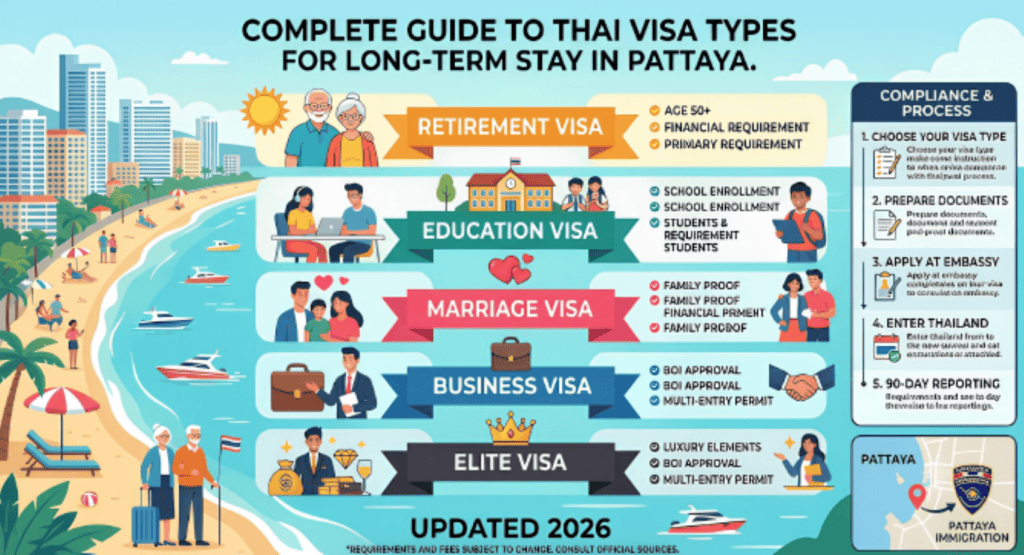
Thailand Visa Guide · Pattaya 2026 All options for a long-term stay | As of June 2026
The complete guide to visa types for a long-term stay in Pattaya
Thailand offers six practical routes to a long-term stay in Pattaya – from the accessible retirement visa to the exclusive 10-year LTR programme. This guide presents each visa type: requirements, costs, legal obligations and how to choose the right visa for your situation.
6 available visa routes
500 baht/day overstay fine (maximum 20,000 baht)
TDAC mandatory digital arrival card (since May 2025)
90 days reporting cycle (for most visas)
30 days visa-exempt entry for many nationalities (since 15 September 2026)
The key changes in 2026
Visa-exempt entry cut to 30 days (15 September 2026): According to the announcement in the Royal Gazette of 31 August 2026, visa-exempt entry for many nationalities has been 30 days (instead of 60) since 15 September 2026. Some bilateral agreements still grant 60–90 days. Always check the current status for your nationality before travelling. (Source: Royal Gazette, 31 August 2026).
TDAC mandatory on every entry (since 1 May 2025): The paper TM6 form has been abolished. The digital arrival card (TDAC) must be completed free of charge at tdac.immigration.go.th within 72 hours before every entry. This also applies to long-term visa holders. A new card is needed for every entry. (Source: Thai Immigration Bureau).
Strict checks on “visa runs” (from November 2025): Repeated visa-exempt entries are now being refused. Entries via land borders are limited to twice a year. Since early 2025, more than 2,900 entries have been refused. (Source: ExpatsThailand).
Visa 1 – Non-Immigrant O-A (retirement visa)
The most common route to a long-term stay for expats over 50. It grants a one-year stay, renewable indefinitely – with no end date, but no route to permanent residence. The Pattaya immigration office (Jomtien area, Soi Siam Country Club) handles all extensions and 90-day reports.
Age: at least 50 years at the time of application. No upper age limit.
Financial requirement (option A – deposit): 800,000 baht in a Thai bank account (in your name). For an extension of stay in Thailand and every annual renewal, the amount must be in the account two months before the application and three months after. When applying through an embassy abroad, the holding period varies (usually two months) – check with the embassy. Always keep more than the minimum of 400,000 baht during the year.
Financial requirement (option B – monthly income): proof of a pension or foreign income of at least 65,000 baht per month (usually via an embassy letter or bank statements).
Health insurance (mandatory): minimum cover of USD 100,000 (or 3,000,000 baht). The threshold of 40,000 baht outpatient and 400,000 baht inpatient applies only to the O-X visa. The insurance must remain active.
Re-entry permit (crucial): Leaving without this permit invalidates the visa. Cost: 1,000 baht single / 3,800 baht multiple.
90-day report: You must report your address every 90 days. Fine for missing it: 2,000 baht.
Advantages: low annual fee (1,900 baht), unlimited extension within Thailand. Limitations: money tied up in the bank, no right to work at all, bureaucracy at renewal.
Visa 2 – DTV (Destination Thailand Visa / digital nomads)
Introduced in July 2024. Thailand’s official visa for remote workers, freelancers and digital nomads. No minimum monthly income – only proof of savings.
Main features: from 20 years of age, valid for 5 years. Multiple entry with 180 days per stay (extendable once to 360 days in a row).
Financial requirement: savings of at least 500,000 baht (or the equivalent in foreign currency) over 3 consecutive months before the application. Money deposited at short notice can lead to refusal.
Proof of employment: employment contract with a foreign company, payslips or a freelancer portfolio. (Language schools are no longer recognised under the “soft power” route.)
Right to work: covers exclusively remote work for employers or clients abroad. Working for Thai companies is prohibited without a local work permit.
Apply only outside Thailand: The application system detects your IP address. Applying while staying in Thailand leads to refusal.
Tax residency risk: Staying more than 180 days a year makes you tax resident in Thailand.
Re-entry permit: not needed. Each new entry automatically grants 180 days. Cost of the application itself: around 10,000 baht.
Visa 3 – LTR (Long-Term Resident Visa)
Thailand’s “golden visa”, administered by the BOI (Board of Investment) rather than the regular immigration office. For the wealthy, wealthy retirees and highly skilled professionals.
Key benefits: valid for 10 years (5+5), reporting once a year (instead of every 90 days), digital work permit included, VIP airport lane and a flat income tax of 17% (for highly skilled professionals).
Category 1 (wealthy global citizen): USD 1 million in total assets, including an investment of USD 500,000 in Thailand.
Category 2 (wealthy pensioner, 50+): passive annual income of at least USD 80,000, or USD 40,000–80,000 plus an investment of USD 250,000 in Thailand.
Category 3 (remote work – professionals): employees of listed companies or of companies with global revenue of USD 150 million or more, earning over USD 80,000 a year.
Important: cryptocurrencies do not count, and years on an LTR visa are not credited towards future permanent residence (PR) in Thailand.
Visa 4 – Thailand Privilege Visa (formerly Thailand Elite)
A government membership programme offering visas of 5 to 20 years for a one-off payment.
Requirements: no age limit, no proof of income, no bank deposit and no mandatory health insurance.
Main costs: Bronze for 5 years for 650,000 baht (applications until 31 December 2026), Gold for 5 years (900,000 baht), Platinum for 10 years (1.5 million baht), Diamond for 15 years (2.5 million baht) and Reserve for 20 years (5 million baht, by invitation only).
VIP service: A personal liaison (EPL) escorts you through the fast immigration lane at the airport, with lounge access and a limousine to your home. Average time at the airport: under 30 minutes.
Right to work: The visa does not grant a work permit in any form. Legal work for a local employer requires a parallel Non-B visa.
Visa 5 – Non-Immigrant O (marriage / family visa)
For foreigners legally married to a Thai national. An excellent, often overlooked alternative to the retirement visa.
Eligibility: You must be officially registered as married at the district office (Amphoe). An unformalised partnership does not count.
Advantages over the retirement visa: no age limit at all. Much lower financial requirement: 400,000 baht in the bank (instead of 800,000) or 40,000 baht monthly income from abroad (instead of 65,000). No obligation to have private health insurance.
Obligations: 90-day report, re-entry permit for trips abroad and annual renewal with marriage certificate and bank statements.
Visa 6 – Non-Immigrant B + work permit
For anyone employed by a Thai company, owning a local business or doing business in Thailand.
Features: always with a separate work permit. The employer must maintain a 4:1 ratio (4 Thai employees for every foreign employee on a visa). This is the least common visa among foreigners in Pattaya, who are mostly retirees or remote workers.
General obligations for everyone
Digital arrival card – TDAC
Mandatory digital replacement for the paper TM6 form (since 1 May 2025). Every foreigner must complete it free of charge at tdac.immigration.go.th within 72 hours before arrival and receives a QR code for immigration control. Mandatory for long-term visa holders too. Don’t pay anything to fraudulent third-party websites that charge for it.
90-day report
Legal obligation for every stay of more than 90 days. Reporting window: 15 days before to 7 days after the due date. 2,000 baht fine if late. Possible online (TM47 system), in person or by post to the immigration office. (LTR visa holders report only once a year.)
Quick comparison – the 6 visa types
| Visa type | Age | Duration | Estimated cost | Legal work | Reporting |
|---|---|---|---|---|---|
| Retirement (O-A) | 50+ | 1 year (renewable) | 1,900 ฿ (annual) | none | every 90 days |
| Digital nomads (DTV) | 20+ | 5 years (180 days per entry) | 10,000 ฿ (one-off) | for abroad only | every 90 days (if staying continuously) |
| Long-Term Resident (LTR) | no limit | 10 years (5+5) | BOI fee | digital permit | once a year |
| Privilege | no limit | 5–20 years | 650,000–5 million ฿ (up front) | none | every 90 days (with assistance) |
| Marriage / family (O) | no limit | 1 year (renewable) | 1,900 ฿ (annual) | none | every 90 days |
| Work / business (Non-B) | no limit | 1 year (renewable) | employer’s costs | with a local employer | every 90 days |
Quick decision guide: which visa suits you?
Are you 50+, retired and able to keep 800,000 baht in a Thai bank? Recommended: Retirement visa (O-A)
Do you work remotely for a foreign employer and have 500,000 baht in savings? Recommended: DTV
Do you have over USD 80,000 passive annual income or work for a large corporation abroad? Recommended: LTR
Do you want zero paperwork, no proof of income and are you willing to pay 650,000 baht up front? Recommended: Thailand Privilege
Are you officially married to a Thai national? Recommended: Marriage visa (O)
Are you employed by a Thai company or setting up a local company? Recommended: Non-B visa + work permit
Note: This information is for general information only and does not constitute legal or immigration advice. Visa rules change frequently. Sources: Siam Legal, HLB Thailand, ThaiEmbassy.com, ExpatDen, Thai Immigration Bureau. Always check the requirements with the embassy or a local lawyer before applying.
Want to invest in Pattaya with confidence?
The Casa Pattaya team supports investors from the search to the key handover – personally, transparently and with on-the-ground experience.


